Introduction to Santa Muerte Prayer
The phrase Santa Muerte prayer carries deep spiritual, cultural, and emotional significance for millions of devotees across the world. Santa Muerte, often translated as “Holy Death,” is a folk saint venerated primarily in Mexico and parts of Latin America, though her presence has grown globally in recent years. Unlike traditional religious figures, Santa Muerte represents death itself, not as something to fear, but as a powerful, honest, and unavoidable force that treats all people equally.
Praying to Santa Muerte is often misunderstood by outsiders. Many assume it is dark, dangerous, or associated only with criminal activity, but this is a shallow interpretation. In reality, Santa Muerte prayers are deeply personal and often rooted in protection, healing, love, justice, gratitude, and guidance through difficult life circumstances. Devotees see her as compassionate, direct, and unwaveringly loyal to those who approach her with sincerity.
What sets a Santa Muerte prayer apart from conventional prayers is its raw honesty. People do not hide their fears, desperation, or flaws when praying to her. Instead, they speak plainly, trusting that Santa Muerte understands the fragility of human life better than any other spiritual figure. This openness is one of the main reasons her devotion continues to grow.
This article explores the origins, meanings, types, and proper practices surrounding Santa Muerte prayer. Whether you are curious, respectful, or already devoted, understanding the depth behind these prayers helps clarify why Santa Muerte holds such a strong spiritual presence.
Origins and Historical Background of Santa Muerte Prayer
The roots of Santa Muerte prayer trace back to pre-Hispanic beliefs in Mesoamerica, long before Spanish colonization. Indigenous cultures such as the Aztecs worshipped deities associated with death, the underworld, and the afterlife. Figures like Mictecacihuatl, the Lady of the Dead, shared symbolic similarities with Santa Muerte. These ancient traditions viewed death not as an end, but as a transition and a natural part of existence.
When Catholicism was introduced to Mexico, indigenous beliefs did not disappear. Instead, they blended with Christian imagery and rituals. Over time, the skeletal figure of death became sanctified in folk practice, even though it was never officially recognized by the Catholic Church. Santa Muerte emerged from this fusion as a spiritual figure who existed outside formal religious structures.
Santa Muerte prayers were traditionally whispered in private, passed down orally, and practiced in secrecy due to fear of persecution. For many years, devotion to Santa Muerte existed on the margins of society, especially among the poor, the sick, prisoners, migrants, and those who felt abandoned by traditional religious institutions.
In the early 21st century, Santa Muerte prayer practices became more visible. Shrines appeared in public spaces, and devotees began openly sharing prayers, novenas, and rituals. Despite criticism from religious authorities, the devotion continued to grow because it addressed real human needs without judgment.
Understanding this history is crucial because it shows that Santa Muerte prayer is not a trend or novelty. It is a spiritual tradition born from survival, cultural resistance, and the human need for comfort in the face of mortality.
Spiritual Meaning Behind Santa Muerte Prayer
At its core, a Santa Muerte prayer is an acknowledgment of life’s impermanence and a request for balance within that reality. Santa Muerte represents death, but not destruction. She symbolizes transformation, protection, and fairness. Devotees believe that because death comes for everyone, Santa Muerte does not discriminate based on wealth, status, or past mistakes.
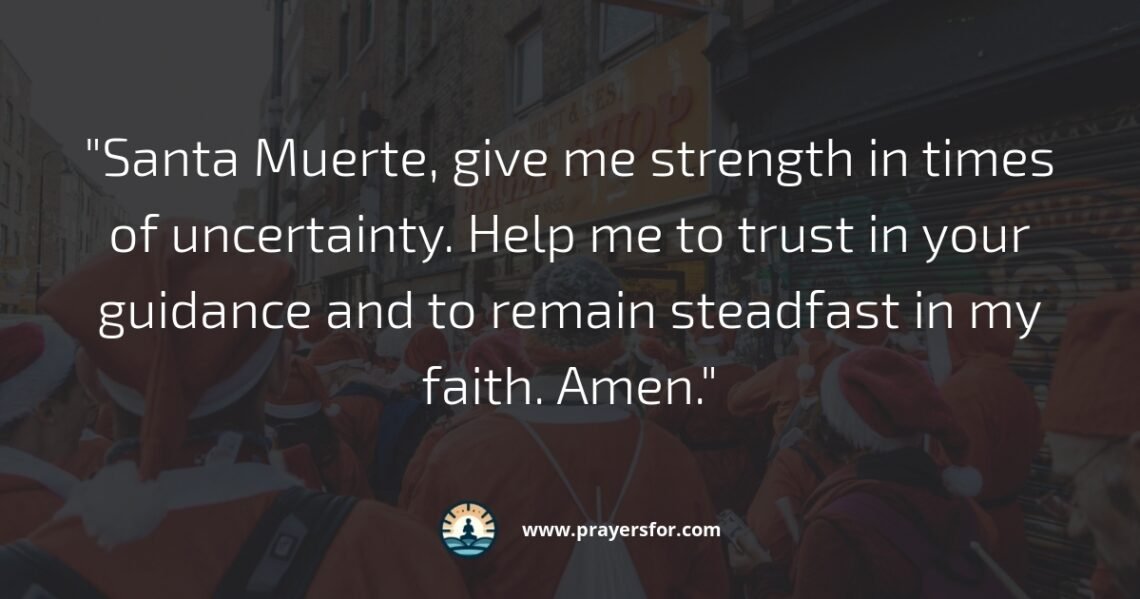
Many people are drawn to Santa Muerte prayer because it allows them to confront fear directly. Instead of praying for death to be avoided, devotees pray for strength, clarity, and safe passage through difficult moments. This spiritual honesty creates a sense of empowerment rather than dread.
Another key spiritual element of Santa Muerte prayer is reciprocity. Devotees often promise offerings, gratitude, or continued devotion in return for her assistance. This is not seen as bargaining but as a relationship built on mutual respect. Santa Muerte is viewed as a protector who expects honesty and commitment.
Santa Muerte prayer also carries themes of justice and truth. Many believe she exposes lies, removes false people from one’s life, and delivers fair outcomes when human systems fail. Because of this, prayers to Santa Muerte often focus on legal issues, betrayals, or situations where someone feels powerless.
Spiritually, praying to Santa Muerte encourages acceptance of life’s cycles. It reminds devotees that endings are not always negative and that death can be a guide rather than an enemy. This perspective helps many people cope with grief, loss, and uncertainty in a healthier, more grounded way.
Types of Santa Muerte Prayer and Their Purposes
Santa Muerte prayers vary widely depending on the intention behind them. One of the most common types is the prayer for protection. These prayers ask Santa Muerte to guard the devotee from harm, negative energy, accidents, or enemies. Protection prayers are often used by people working dangerous jobs, traveling frequently, or facing hostile environments.
Another widely practiced form is the Santa Muerte prayer for love. Contrary to popular myths, these prayers are not always about manipulation or obsession. Many devotees pray for emotional healing, reconciliation, self-love, or the removal of toxic relationships. Santa Muerte is believed to bring clarity and honesty into matters of the heart.
Health-related Santa Muerte prayers are also common. Devotees pray for recovery from illness, relief from chronic pain, or strength during medical treatments. Because Santa Muerte governs the boundary between life and death, many believe she offers comfort and support during health crises.
Prayers for justice and legal matters form another category. People who feel wronged by legal systems, employers, or personal relationships often turn to Santa Muerte. These prayers seek truth, fairness, and resolution rather than revenge. Devotees believe Santa Muerte reveals hidden motives and restores balance.
Finally, there are gratitude prayers. Not every Santa Muerte prayer asks for something. Many are expressions of thanks for protection already given, lessons learned, or hardships survived. These prayers strengthen the spiritual bond between the devotee and Santa Muerte and reinforce a sense of humility and appreciation.
How Santa Muerte Prayer Is Practiced
Practicing a Santa Muerte prayer is deeply personal, but certain traditions are commonly followed. Many devotees create a small altar with a statue or image of Santa Muerte. This space serves as a spiritual focal point where prayers are offered regularly. Altars are often decorated with candles, flowers, water, incense, and symbolic items.
Candles play an important role in Santa Muerte prayer rituals. Different candle colors are believed to represent different intentions. For example, white candles symbolize purity and protection, red candles are associated with love and passion, and black candles represent deep transformation and protection against negativity. The candle is lit while the prayer is spoken with focus and sincerity.
Timing can also be meaningful. Some devotees pray at night, believing that Santa Muerte’s energy is strongest during quiet, reflective hours. Others pray daily, making it part of their routine, while some only pray during moments of crisis or gratitude.
What matters most in Santa Muerte prayer is intention. There is no requirement for memorized words or elaborate rituals. Many prayers are spoken from the heart, using simple language and direct emotion. Devotees believe Santa Muerte values honesty over formality.
Offerings are another important aspect. These may include food, drinks, flowers, or symbolic objects. Offerings are not bribes but gestures of respect and appreciation. They represent the devotee’s willingness to maintain a balanced spiritual relationship.
Misconceptions and Controversy Surrounding Santa Muerte Prayer
Santa Muerte prayer has been surrounded by controversy, largely due to misunderstanding and sensationalism. Media portrayals often link Santa Muerte exclusively to crime or dark magic, ignoring the millions of peaceful devotees who pray for health, safety, and guidance.
One common misconception is that Santa Muerte worship promotes death or harm. In reality, most prayers focus on preserving life, avoiding danger, and finding peace. Santa Muerte is not prayed to in order to cause death but to navigate life’s uncertainties with courage and protection.
Another misunderstanding is that Santa Muerte prayer is anti-religious. Many devotees identify as Catholic or Christian and see Santa Muerte as a complementary spiritual figure rather than a replacement. They believe faith is personal and that spiritual comfort can come from multiple sources.
Critics often focus on extreme or unethical practices while ignoring the everyday reality of devotion. Like any belief system, Santa Muerte prayer can be misused, but misuse does not define the tradition as a whole. Most devotees emphasize responsibility, respect, and ethical intent.
Understanding these misconceptions helps create a more accurate picture of Santa Muerte prayer as a spiritual practice rooted in human vulnerability, resilience, and cultural history rather than fear or superstition.
Why Santa Muerte Prayer Continues to Grow Worldwide
The global rise of Santa Muerte prayer reflects changing spiritual needs in modern society. Many people feel disconnected from traditional institutions or judged by rigid moral frameworks. Santa Muerte offers a non-judgmental presence that accepts people as they are.
In times of uncertainty, economic struggle, migration, and social change, Santa Muerte prayer provides comfort and stability. Her symbolism resonates with those who face daily risks or feel invisible within larger systems. She represents survival, dignity, and the truth that life is fragile yet meaningful.
Social media and migration have also contributed to the spread of Santa Muerte devotion. Prayers that were once private are now shared across borders, creating global communities of believers who exchange experiences and spiritual practices.
The continued growth of Santa Muerte prayer suggests that people are seeking spiritual figures who acknowledge hardship without shame. Santa Muerte does not promise perfection or eternal happiness. Instead, she offers presence, honesty, and protection through life’s inevitable challenges.
Conclusion: The Deeper Value of Santa Muerte Prayer
Santa Muerte prayer is far more than a spiritual curiosity. It is a deeply rooted practice shaped by history, culture, and the universal human experience of mortality. For devotees, praying to Santa Muerte is an act of trust, acceptance, and courage in the face of uncertainty.
By understanding the origins, meanings, and intentions behind Santa Muerte prayer, it becomes clear why this devotion continues to thrive. It offers comfort without judgment, protection without illusion, and spirituality grounded in real life rather than idealized perfection.