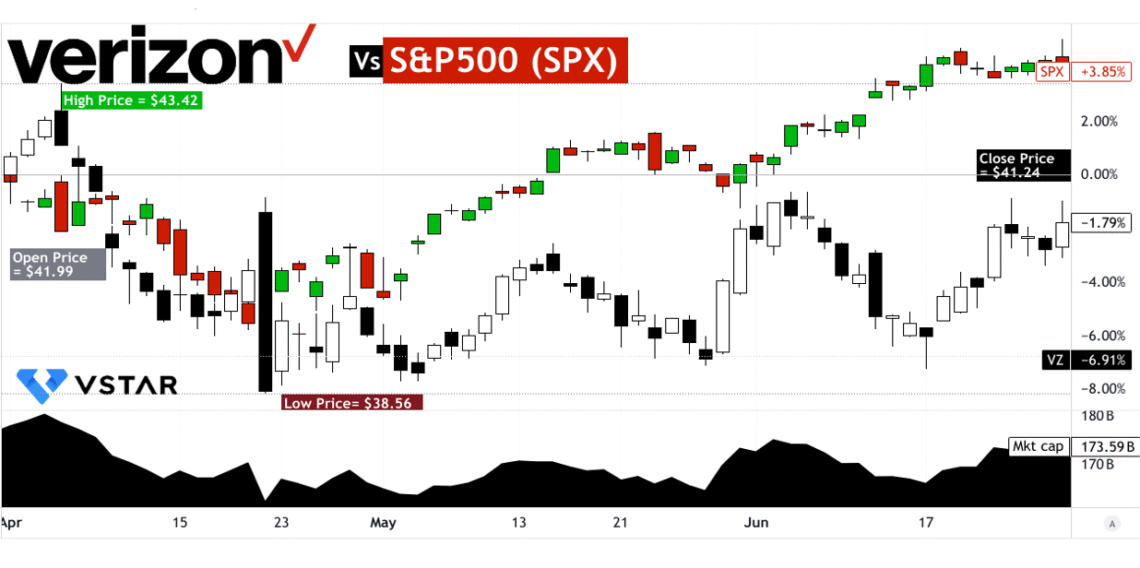
The VZ stock price is closely watched by investors who want exposure to one of the largest telecommunications companies in the United States. Verizon Communications Inc., which trades under the ticker symbol VZ on the New York Stock Exchange, is widely known for its wireless network, broadband business, strong cash generation, and long history of paying dividends.
As of the October 2, 2026 market close, VZ was trading around $45.92 per share, with an after-hours price near $45.96. The stock’s 52-week range was approximately $38.39 to $51.68.
For investors, however, looking at one price is not enough. The bigger question is why the VZ stock price moves, whether Verizon’s business is improving, and what could influence the shares over the coming months. Verizon’s latest operating results provide some encouraging signals, but the company still faces competition, debt, and the challenges that come with running a mature telecommunications business.
What Is VZ Stock?
VZ is the stock ticker for Verizon VZ Stock Price Communications Inc., a major American telecommunications company. Verizon provides wireless services, broadband connections, business communications, and other technology-related services to consumers, businesses, and government customers.
The company operates primarily through its Consumer and Business segments. Its consumer operations include wireless services and broadband products, while its business operations serve organizations with communications and technology solutions. Verizon’s shares are listed on the New York Stock Exchange and Nasdaq under the ticker VZ.
Because Verizon operates in an essential VZ Stock Price industry, its stock is often viewed differently from high-growth technology companies. People continue to need mobile connections and internet access regardless of economic conditions. That gives Verizon a defensive quality, although it does not make the stock immune to market volatility.
VZ Stock Price Today
The VZ stock price closed at approximately $45.92 on October 2, 2026. The regular trading session saw the shares move between roughly $45.79 and $46.39. The stock’s market capitalization was around $191.5 billion at the latest quoted price.
The recent price is below Verizon’s 52-week high of $51.68. MarketWatch reported that the stock had fallen to $45.98 on September 29 after three consecutive sessions of declines, leaving it more than 11% below its March 2026 high.
That pullback is important because investors should not automatically interpret a decline as either a buying opportunity or a warning sign. A stock can fall because expectations have changed, because the broader market is weak, or simply because investors are taking profits. The underlying business results matter just as much as the chart.
How the VZ Stock Price Has Been Performing
Verizon’s shares have experienced meaningful VZ Stock Price movement during 2026. The stock reached a 52-week high of $51.68 and a low of $38.39, showing a substantial difference between the year’s strongest and weakest trading levels.
This range tells investors that VZ can behave differently depending on market expectations. When investors become more confident about Verizon’s customer growth, cash flow, cost controls, and dividend strength, demand for the shares can increase. On the other hand, concerns about competition, debt, or slower growth can pressure the valuation.
The recent decline from the 52-week high also demonstrates why investors should avoid judging Verizon solely by its dividend yield. A high dividend can provide income, but changes in the share price can have a major impact on total returns. For long-term investors, both income and capital appreciation deserve attention.
Verizon’s Latest Business Performance
One of the most important developments for the VZ stock price is Verizon’s operating performance during 2026. The company reported strong second-quarter results and raised its full-year guidance for the second consecutive quarter.
During the second quarter of 2026, mobility and broadband service revenue increased 2.8%. Verizon also reported 184,000 postpaid phone net additions, which the company described as its strongest consumer second-quarter postpaid phone additions in five years. Total mobility and broadband net additions exceeded 550,000.
These numbers matter because subscriber growth VZ Stock Price is a key indicator for a telecommunications company. Verizon does not need to grow at the pace of a young technology company. Instead, investors generally want to see stable customer numbers, better revenue trends, disciplined costs, and strong cash flow. The latest results suggest that some of those areas are moving in a favorable direction.
Why Verizon Raised Its 2026 Guidance
Verizon’s improved outlook is another factor investors should watch when analyzing the VZ stock price. After its second-quarter performance, the company raised its full-year guidance for several important measures, including mobility and broadband service revenue, operating cash flow, free cash flow, and adjusted earnings per share.
The company also increased its full-year share buyback target to as much as $4.5 billion. In the first half of 2026, Verizon said it returned $9.4 billion in total capital to shareholders.
Higher guidance can influence a stock because it VZ Stock Price changes expectations about future earnings and cash generation. If Verizon continues to meet or exceed its targets, investors may become more comfortable assigning a stronger valuation to the shares. If performance falls short, the opposite can happen.
VZ Stock and Verizon’s Dividend
The dividend is one of the biggest reasons investors follow VZ stock. Verizon has built a reputation as an income-oriented investment, and the company has increased its dividend for many consecutive years.
In June 2026, Verizon declared a quarterly dividend of 70.75 cents per share. The company also highlighted its record of 20 consecutive years of dividend increases.
At the October 2 share price, market data showed an annual dividend of about $2.83 per share and a dividend yield of approximately 6.16%.
A dividend yield at that level can look attractive compared with many other large companies. Still, investors should remember that yield changes when the stock price changes. A VZ Stock Price falling share price can push the yield higher even if the dividend itself has not increased.
Is VZ Stock Cheap or Expensive?
Valuation is another major part of the VZ stock price discussion. Verizon currently trades at a relatively modest earnings multiple compared with many growth-focused companies. Market data showed a trailing P/E ratio close to 12 and a forward P/E around 9.
That relatively low valuation reflects the nature of Verizon’s business. The company has a huge customer base and substantial infrastructure, but it is not generally expected to deliver explosive revenue growth. Investors therefore tend to focus heavily on dividends, cash flow, debt management, and steady earnings.
A low P/E ratio does not automatically mean that a stock is undervalued. It can also indicate that investors expect limited growth or see meaningful risks. For VZ, the right valuation depends on whether management can improve growth while maintaining financial discipline.
Competition Could Affect the VZ Stock Price
The U.S. telecommunications market remains highly competitive. Verizon competes with major carriers such as AT&T and T-Mobile, while cable companies and other providers also compete in broadband.
Competition can affect Verizon in several ways. Aggressive promotions may increase customer acquisition costs, while pricing pressure can make it harder to increase revenue per VZ Stock Price customer. The company must therefore balance customer growth with profitability.
Verizon’s recent subscriber results are encouraging, but investors will want to see whether those gains can continue. Sustained customer growth combined with stronger service revenue would provide a much better long-term signal than a single strong quarter.
Debt and Cash Flow Remain Important
Telecommunications companies require enormous amounts of capital to maintain networks and invest in new technologies. Verizon therefore carries substantial debt, making cash flow an important part of its investment story.
Investors need to consider how much cash the company generates after operating expenses and capital investments. Strong free cash flow gives Verizon more flexibility to pay dividends, reduce debt, invest in infrastructure, and repurchase shares.
This is one reason Verizon’s guidance for cash flow is worth VZ Stock Price following closely. The company raised its full-year free cash flow and operating cash flow outlook in 2026, which provides a positive signal for shareholders if the targets are achieved.
What Analysts Expect From VZ Stock
Analyst expectations provide another perspective, although they should never be treated as guaranteed predictions. MarketBeat reported a consensus Hold rating based on 20 analyst ratings, with 12 Holds and 8 Buys. Its reported average price target was approximately $50.90.
That target would represent upside from the October 2 closing price. However, analysts can change their targets quickly when earnings, interest rates, competitive conditions, or company guidance changes.
Interestingly, one recent analyst action showed Scotiabank lowering its VZ target from $52.50 to $51.50 while maintaining a Sector Outperform rating. This illustrates why investors should look at the overall range of opinions rather than focusing on one target.
What Could Drive VZ Stock Higher?
Several factors could potentially support the VZ stock price. Continued subscriber growth would be one of the most important. If Verizon can consistently add customers while protecting margins, investors may become more optimistic about the company’s growth outlook.
Another potential catalyst is stronger cash generation. Verizon has indicated that its transformation and cost-control efforts are helping improve financial performance. Successful execution could support dividends, buybacks, and debt management at the same time.
The company’s broadband expansion could also matter. Fixed wireless access and other broadband offerings give Verizon opportunities to increase its relationship with customers beyond traditional mobile services. Stronger convergence between wireless and broadband could become an important part of the company’s long-term strategy.
What Could Push VZ Stock Lower?
There are also clear risks. The biggest concern is that telecommunications competition could remain intense. If Verizon has to spend heavily on promotions to retain or attract customers, revenue growth may not translate into equally strong profit growth.
Debt and interest costs are another consideration. Large infrastructure businesses naturally require significant financing, and changes in interest rates can affect borrowing costs and investor sentiment.
There is also execution risk. Verizon is going through a strategic transformation, and management must prove that its plans can deliver sustainable improvements. Investors will be watching future earnings reports closely to determine whether recent improvements represent a lasting trend or simply a strong period.
When Is Verizon’s Next Earnings Report?
Verizon’s investor calendar lists its third-quarter 2026 earnings event for October 26, 2026, at 8:30 a.m. Eastern Time.
That report could become an important short-term catalyst for the VZ stock price. Investors will likely pay attention to subscriber additions, service revenue, adjusted earnings, free cash flow, and management’s updated full-year outlook.
The earnings report may also provide additional information about the company’s strategic transformation and capital allocation. For investors considering VZ, watching the numbers behind the headline EPS figure can provide a much clearer picture of the company’s health.
Is VZ Stock Worth Watching?
For income-focused investors, VZ remains an VZ Stock Price interesting stock to watch. Its established telecommunications business, large customer base, dividend history, and significant cash generation give it characteristics that are different from high-growth stocks.
The current valuation also makes the shares interesting for investors who prefer established companies at relatively modest earnings multiples. However, the stock is not without risks. Growth is likely to remain slower than in many technology companies, and competition, debt, capital requirements, and execution will continue to matter.
The recent 2026 results provide some encouraging evidence that Verizon is improving its operating momentum. The company has reported stronger customer additions and raised its financial guidance twice during the year.
Final Thoughts on the VZ Stock Price
The VZ stock price is influenced by much more than daily market movements. Verizon’s subscriber growth, revenue trends, free cash flow, dividend policy, debt position, competition, and management strategy all play a role in determining how investors value the company.
At around $45.92 after the October 2, 2026 close, VZ remains below its 52-week high but offers a substantial dividend yield. Recent operating results are encouraging, particularly the improvement in customer additions and the company’s decision to raise its 2026 guidance.
Still, investors should avoid treating any analyst target or current price as a guaranteed future outcome. Verizon is a mature company operating in a highly competitive industry. The most useful approach is to follow its quarterly results, cash flow, subscriber trends, dividend coverage, and management’s progress over time.
For anyone researching VZ, the upcoming third-quarter earnings report on October 26 could provide another important piece of the puzzle. Ultimately, whether Verizon is attractive depends on an investor’s goals, risk tolerance, income requirements, and expectations for the telecommunications sector.